
NTC Thermistors Explained – How They Work & Applications
Accurate temperature measurement is essential across industrial automation, medical equipment, HVAC systems, automotive electronics and energy management systems. One of the most widely used temperature sensing technologies is the NTC thermistor.
An NTC thermistor provides a reliable, accurate and cost-effective method of measuring temperature by using the predictable relationship between temperature and electrical resistance.
At Peak Sensors, we design and manufacture temperature sensing solutions including NTC thermistor assemblies for applications where accuracy, reliability and long service life are critical. Understanding the operating principles, characteristics and selection requirements of NTC thermistors helps engineers choose the correct sensor for their system.
This guide explains what an NTC thermistor is, how it works, how to test one, where they are used and how to select the right temperature sensor for an application.

What is a Thermistor?
A thermistor is a temperature-sensitive resistor that changes its electrical resistance depending on temperature.
The word thermistor comes from:
- Therm – temperature
- Resistor – electrical resistance
Unlike a standard resistor, which maintains a relatively fixed resistance value, a thermistor is specifically manufactured to provide predictable resistance changes as temperature varies.
There are two main types of thermistors:
| Type | Meaning | Resistance Behaviour |
|---|---|---|
| NTC Thermistor | Negative Temperature Coefficient | Resistance decreases as temperature increases |
| PTC Thermistor | Positive Temperature Coefficient | Resistance increases as temperature increases |
NTC thermistors are primarily used for accurate temperature measurement and control, while PTC thermistors are often used for protection circuits and switching applications.
What Does NTC Thermistor Stand For?
NTC thermistor stands for Negative Temperature Coefficient thermistor.
The term “negative temperature coefficient” means that the electrical resistance decreases when temperature increases.
| Temperature | Resistance |
|---|---|
| Low temperature | High resistance |
| Medium temperature | Lower resistance |
| High temperature | Low resistance |
This predictable resistance-temperature relationship allows electronic controllers to calculate temperature accurately.
What is an NTC Thermistor?
An NTC thermistor is a semiconductor temperature sensor made from ceramic materials that exhibit a negative temperature coefficient.
When the temperature of the sensing element increases, more charge carriers become available within the semiconductor material. This allows electrical current to flow more easily, reducing resistance.
NTC thermistors are commonly specified by:
- Resistance at 25°C (R25)
- Beta value (β)
- Operating temperature range
- Accuracy tolerance
- Thermal response time
- Physical construction
Common resistance values include:
- 2 kΩ
- 5 kΩ
- 10 kΩ
- 100 kΩ
A 10 kΩ NTC thermistor at 25°C is one of the most commonly used configurations in temperature sensing applications.
How Does an NTC Thermistor Work?
An NTC thermistor works by converting temperature changes into measurable resistance changes.
The relationship between temperature and resistance is non-linear.
As temperature increases:
- Semiconductor activity increases.
- Electrical resistance decreases.
- The measuring circuit detects the resistance change.
- A controller converts resistance into temperature.
Most electronic systems use an NTC thermistor within a voltage divider circuit. The controller measures the changing voltage and calculates the corresponding temperature.
For higher accuracy applications, engineers may use mathematical models such as the Beta equation or Steinhart–Hart equation.
NTC Thermistor Characteristics Engineers Should Consider
When selecting an NTC thermistor, engineers should consider several key performance characteristics.
Resistance Value (R25)
The nominal resistance is normally specified at 25°C.
For example:
- 10 kΩ at 25°C
- 100 kΩ at 25°C
The resistance value determines how the sensor interfaces with the measurement electronics.
Beta Value (β)
The Beta value describes how quickly resistance changes with temperature.
A higher Beta value generally indicates a greater resistance change over a given temperature range.
The Beta equation is:
1/T = 1/T₀ + (1/β) ln(R/R₀)
Where:
- T = temperature in Kelvin
- T₀ = reference temperature
- R = resistance at temperature T
- R₀ = resistance at reference temperature
- β = Beta value
Accuracy and Tolerance
NTC thermistors are available in different accuracy grades.
Typical tolerances include:
- ±0.5°C
- ±0.2°C
- ±0.1°C
High-precision applications may require individual calibration to achieve maximum accuracy.
Response Time
The thermal response time describes how quickly the sensor reacts to temperature changes.
Factors affecting response time include:
- Sensor size
- Encapsulation material
- Probe design
- Installation method
Smaller thermistors typically respond faster than larger protected assemblies.
What Are NTC Thermistors Made Of?
NTC thermistors are generally manufactured from semiconductor ceramic materials.
Common metal oxide materials include:
- Manganese oxide
- Nickel oxide
- Cobalt oxide
- Copper oxide
- Iron oxide
These materials are mixed, formed and sintered at high temperatures to create a stable ceramic sensing element.
The sensing element is then protected using different encapsulation methods, including:
- Epoxy coating
- Glass encapsulation
- Stainless steel probes
- Custom sensor housings
The choice of construction depends on environmental requirements such as temperature range, moisture exposure and mechanical durability.
What Are NTC Thermistors Used For?
NTC thermistors are used in thousands of temperature monitoring and control applications.
Industrial Temperature Monitoring
Industrial equipment uses NTC thermistors to monitor:
- Motors
- Pumps
- Compressors
- Control systems
- Manufacturing equipment
They provide early warning of overheating and help improve equipment reliability.
HVAC Temperature Sensors
Heating, ventilation and air conditioning systems commonly use NTC thermistors for:
- Air temperature measurement
- Pipe temperature monitoring
- Refrigeration systems
- Heat pumps
Medical Equipment
Medical devices require accurate temperature measurement for:
- Patient monitoring equipment
- Laboratory instruments
- Diagnostic systems
Automotive and Battery Systems
Electric vehicles and battery systems use NTC thermistors for:
- Battery temperature monitoring
- Charging control
- Thermal management systems
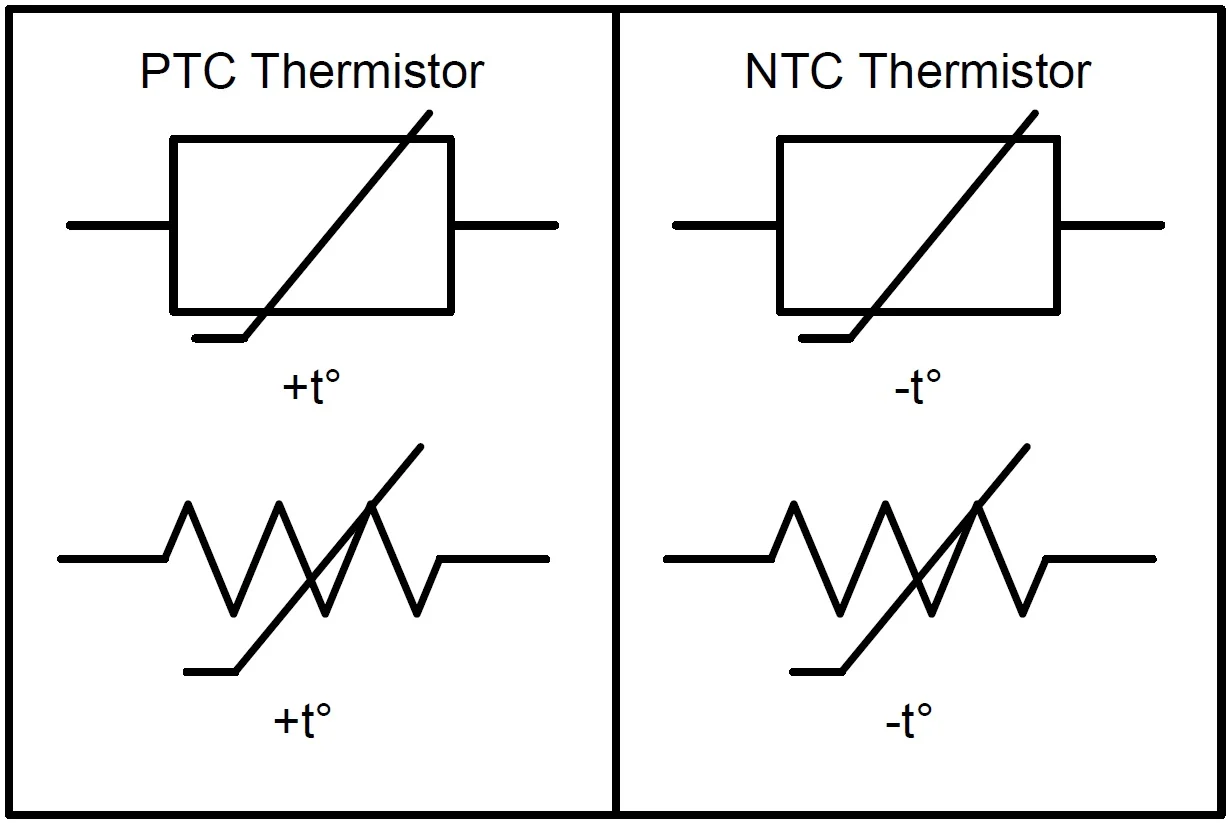
Symbol for a Thermistor
The symbol for a thermistor is based on the standard resistor symbol with an additional diagonal line indicating temperature sensitivity.
Electrical drawings may show:
- A resistor symbol
- A diagonal temperature indicator line
- Markings identifying NTC or PTC characteristics
The exact symbol may vary depending on the electrical drawing standard being used.
What is the Difference Between PTC and NTC Thermistor?
The main difference between PTC and NTC thermistors is how their resistance changes with temperature.
| Feature | NTC Thermistor | PTC Thermistor |
|---|---|---|
| Resistance change | Decreases with temperature | Increases with temperature |
| Main purpose | Temperature measurement | Protection and switching |
| Accuracy | High | Moderate |
| Typical use | Sensors | Overcurrent protection |
NTC thermistors are generally preferred when accurate temperature measurement is required.
How to Identify NTC and PTC Thermistor
To identify whether a thermistor is NTC or PTC:
- Check the manufacturer’s part number.
- Review the technical datasheet.
- Measure resistance at room temperature.
- Apply controlled heat.
- Observe the resistance change.
If resistance decreases when heated, it is an NTC thermistor.
If resistance increases when heated, it is a PTC thermistor.
How to Tell if a Thermistor is NTC
A simple practical test can determine whether a thermistor is NTC.
- Measure the resistance using a multimeter.
- Warm the sensor carefully.
- Monitor the resistance reading.
An NTC thermistor will show a falling resistance value as temperature increases.
How to Test an NTC Thermistor with a Multimeter
Testing an NTC thermistor with a multimeter is straightforward.
Step 1: Disconnect the Sensor
Remove the thermistor from the circuit to avoid inaccurate readings.
Step 2: Measure Resistance
Set the multimeter to resistance mode (Ω).
Measure the resistance at room temperature.
Step 3: Apply Heat
Warm the thermistor gently using your hand or controlled heat source.
Step 4: Check Resistance Change
A working NTC thermistor should show a smooth decrease in resistance.
Signs of failure include:
- No resistance reading
- Infinite resistance
- Unstable readings
- Incorrect resistance values
How to Choose an NTC Thermistor?
Choosing the correct NTC thermistor depends on the application requirements.
Engineers should consider:
Operating Temperature Range
Select a sensor capable of operating across the expected temperature range.
Accuracy Requirements
Higher accuracy applications may require calibrated sensors.
Mechanical Design
Consider:
- Probe diameter
- Cable length
- Mounting method
- Environmental protection
Response Requirements
Fast-response sensors are ideal where rapid temperature changes must be detected.
At Peak Sensors, custom NTC thermistor assemblies can be designed to meet specific application requirements, including bespoke probe designs and environmental protection.
How Do NTC Thermistors Fail?
Although NTC thermistors are highly reliable, failure can occur due to:
- Excessive temperature exposure
- Mechanical damage
- Moisture penetration
- Thermal shock
- Incorrect installation
- Electrical overstress
Common failure symptoms include:
- Incorrect temperature readings
- Open circuit
- Short circuit
- Slow response
Correct sensor selection and installation significantly improve operating life.
Frequently Asked Questions
Are NTC thermistors accurate?
Yes. High-quality NTC thermistors provide excellent temperature accuracy, particularly when correctly specified and calibrated.
What temperature range can NTC thermistors measure?
Typical NTC thermistors operate from approximately -50°C to +150°C, although specialist designs can operate outside this range.
Why are NTC thermistors widely used?
They are popular because they offer:
- High sensitivity
- Fast response
- Small size
- Low cost
- Reliable performance
Can Peak Sensors provide custom NTC thermistors?
Yes. Peak Sensors designs temperature sensing solutions for industrial and specialist applications requiring customised performance and mechanical designs.
Tell Us About Your Temperature Measurement Requirement
Submit an Enquiry
"*" indicates required fields